How to Clean a Microwave That Smells Of Last Week’s Lasagna
Sunshine on 23 September, 2025 | Comments Off on How to Clean a Microwave That Smells Of Last Week’s Lasagna
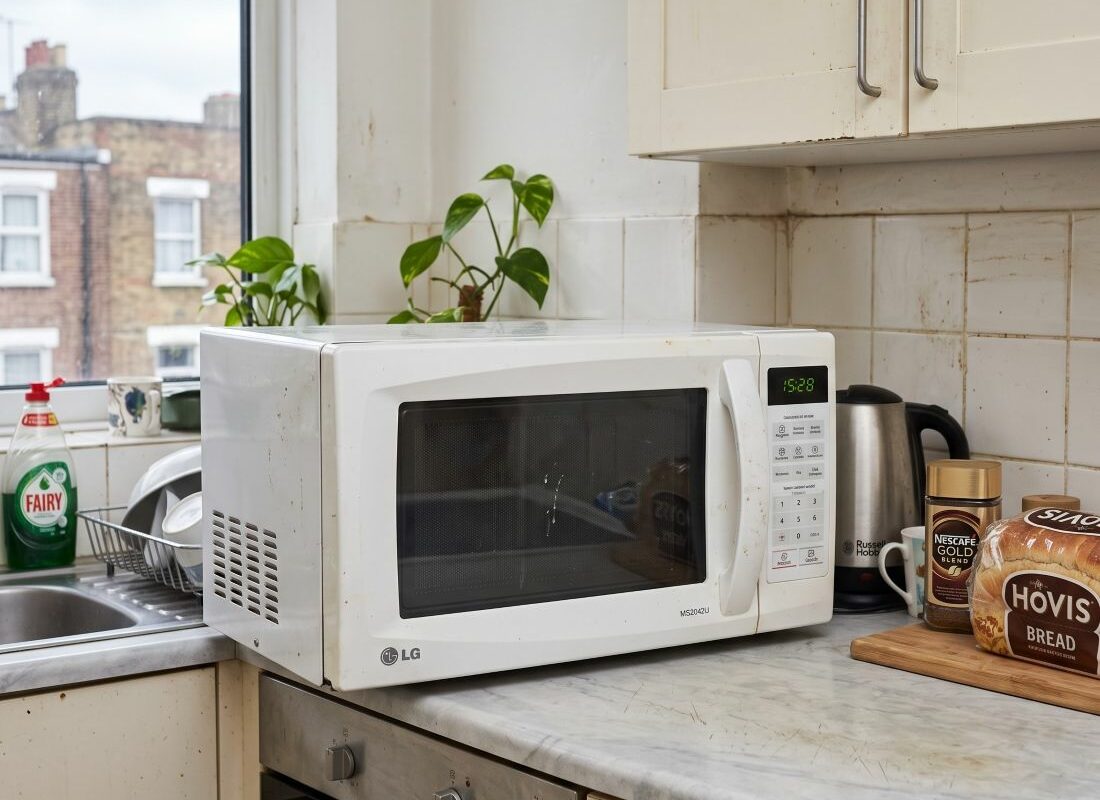
A microwave that smells of last week’s dinner isn’t dirty in the way a smell suggests. Somewhere in there is a physical scrap of food – a fleck of lasagna welded to the roof, a dribble of tomato sauce that ran under the turntable – and it’s sitting there quietly going off. Air freshener won’t touch it. A wipe round the obvious bits won’t help either, because the obvious bits aren’t where the smell is. The job is to steam the cavity soft and lift out the one scrap that’s rotting. Everything else is theatre.
Why does a microwave hold onto a smell like that?
Because of how it cooks. A microwave heats the water in food fast, so anything with moisture – a lasagna especially, all that sauce and melted cheese – bubbles up and throws fine splatter onto every surface around it. That splatter gets cooked on by the next thing you heat, baked into a thin brown varnish across the walls and, worse, across the roof you never look at. Each layer holds a little of the smell of whatever made it. A well-used microwave is basically a scent archive of everything the household has ever reheated.
Shared kitchens are the worst offenders, because nobody owns the mess. The smell builds and builds because the food is still in there, in miniature, in a dozen spots at once.
The spots the smell hides that you never look at
People clean the floor of the cavity and the inside of the door, and stop. The smell is rarely in either. It’s up on the roof, where soup and sauce have erupted upward and dried in place well out of your eyeline. It’s down in the recess the turntable sits in, under the roller ring, where liquid runs down and pools and no cloth ever reaches. There’s your culprit, most of the time – lift the glass plate and the ring out and look at the well underneath, and you’ll often find the source of a fortnight’s mystery smell sitting there in one grim ring of dried sauce.
What’s the steam trick, and does it really work?
It works, and it’s the only method I bother with for the inside. Half-fill a microwave-safe bowl with water, drop in a few slices of lemon or a good splash of white vinegar, and run it on full power for four or five minutes, until it’s boiling hard and the whole cavity has fogged with steam. Then – and this is the part people skip – leave the door shut for another five minutes and let the steam keep working. When you open it, the baked-on splatter that would have needed a scraper wipes away with a damp cloth in a single pass, because the steam has softened it right through. Roof, walls, floor, door. One cloth, no scrubbing.
Mind the bowl coming out, because it’ll be scalding, and mind the first waft of steam at the door. That’s the whole technique. A spray-on “microwave cleaner” does the same job for five times the price and half the result, which is why there’s a lemon in my kit and no microwave spray.
Lemon or vinegar, and why you never run it empty
Either works, because it’s the acid steaming up that cuts the grease and takes the edge off the smell. Lemon leaves the cavity smelling fresher; vinegar is cheaper and a shade better on grease, and its own smell blows off within a minute of the door opening, so don’t let that put you off it. The one rule that isn’t up for debate: never run the microwave empty, or with a bowl that’s boiled dry. With no water inside to soak up the energy, a microwave feeds it back into the magnetron and can wreck itself – so keep half an eye on the bowl, and don’t wander off for ten minutes.
How do you get the smell out for good rather than mask it?
You hunt the source. Once the cavity is steamed and wiped, the smell is either gone or it isn’t, and if it isn’t, there is still food somewhere you haven’t reached. Take the turntable plate and the roller ring out and wash them properly in the sink – the ring collects a shocking amount of gunk between its little wheels, and it’s often the smelliest single object in the whole appliance. Wipe out the recess underneath it. Run a damp cloth along the door seal and into the shut-line of the door, where splatter creeps in and dries. Check the vents, that little grille up on the roof or the side, because grease-laden steam gets pulled through there and coats the edges.
I got called to a four-bed flatshare in Tooting once for a fridge that had packed up, and while I was in the kitchen the microwave was giving off a smell that made your eyes water – the kind of kitchen where nobody quite owns the microwave, and nobody had cleaned it in the eighteen months they’d all lived there. The steam trick knocked the worst of it back, but a ghost of it hung on, and it turned out a burst of something orange – bolognese, by the colour – had fired up through the roof vent and dried solid inside the grille. There’s your culprit. I wiped that out and the smell went with it. Not one of them had thought to look up.
Once the food itself is gone and there’s still a faint stale note left in the plastic, that’s the moment for an absorber, and not a moment before. A bowl of bicarbonate of soda left in the closed microwave overnight draws the lingering odour out of the cavity, and a shallow dish of used coffee grounds does much the same. Absorbers finish the job. They don’t do it – put a bowl of bicarb in a microwave that still has old bolognese up the vent, and all you’ve got is a bowl of bicarb sitting next to a smell.
The overnight bicarbonate-of-soda sit
Bicarb is the one worth keeping in the cupboard for this. Tip a couple of spoonfuls into an open bowl, sit it inside, shut the door and leave it overnight, and it neutralises the stale odours the steam couldn’t carry off. In the morning, bin the bicarb and give the interior one last wipe. For a smell that really won’t quit, a cut lemon left in there overnight does a gentler version of the same and leaves the cavity smelling of something you’d happily reheat toast in. What none of it will do is cover for food you left behind, so do the finding first and the freshening second.
What should you never do to the inside of a microwave?
A few things, and the first is about your safety rather than the finish. No bleach, and no strong kitchen degreaser. You heat food in this box and you breathe the first blast of whatever’s coating it the second the door opens, so anything you wouldn’t happily eat off has no business on those walls, and a warm cavity drives the fumes straight back out at you. A lemon and hot water clean it perfectly well; there’s no argument for anything harsher.
Skip the wire wool and the scouring pads too. The cavity is painted steel, and once you’ve scratched through the coating to bare metal, steam and food acid will start it rusting outward from that scratch, which is a far worse problem than a bit of baked-on sauce. And keep any spray away from the vents – you want grease wiped off the grille, not liquid pushed back into the workings behind it.
The waveguide cover you mustn’t scrub
On the right-hand wall of most microwaves there’s a small panel that looks like thin cardboard or a piece of grubby beige plastic. That’s the waveguide cover, and it’s the one part of the interior you leave nearly alone. A light wipe with a damp cloth is as far as you go, because it’s made of mica, it turns brittle with age, and a torn or missing cover lets the oven arc and spark against the food splatter on the wall behind it. Scrub it or prise it off and you’re into real trouble. If yours has gone dark brown and flaky at the edges, that’s a replacement job, not a cleaning one, and cleaning a damaged one doesn’t make it safe.
How do you keep it from getting back to that state?
Cover your food. That’s the whole of prevention in two words – a plate, or a proper vented lid over the bowl, and the splatter that becomes next month’s smell never lands to begin with. The messiest offenders are the ones worth covering without fail: anything tomato, and anything with a thin sauce that spits the moment it gets hot. Two seconds of a cover saves you ten minutes of steam-and-hunt down the line, every time.
Wipe it while it’s warm, and air it after
Wipe the cavity out while it’s still warm from cooking, when a single pass lifts what would otherwise bake on hard by tomorrow. Leave the door open for a few minutes after anything strong-smelling, so the cavity airs off instead of sealing the steam against the walls. And pull the roller ring out to wash whenever you think of it, because that recess is where the smell breeds – there’s your culprit nine times in ten, and a rinsed ring never gets its chance. In a shared kitchen, the rota nobody keeps is the one for the microwave, so if it falls to you, the day you cook the worst of it is the day to give it a wipe.
A quick wipe after the messy meals, and a proper lemon-steam once a week or so, and you never get near the state that has someone typing “microwave smells of lasagna” into their phone at eleven at night. My own one at home gets the lemon on a Sunday and a wipe whenever I remember. It hasn’t smelled of anything in years.